
100 years of Mosfilm
In this block you will feel nostalgic and plunge into the world of creativity and cinema! Follow in the footsteps of your favourite characters from Soviet films, feel the atmosphere of the era and find out where cult films were shot and where legendary characters spent their time.
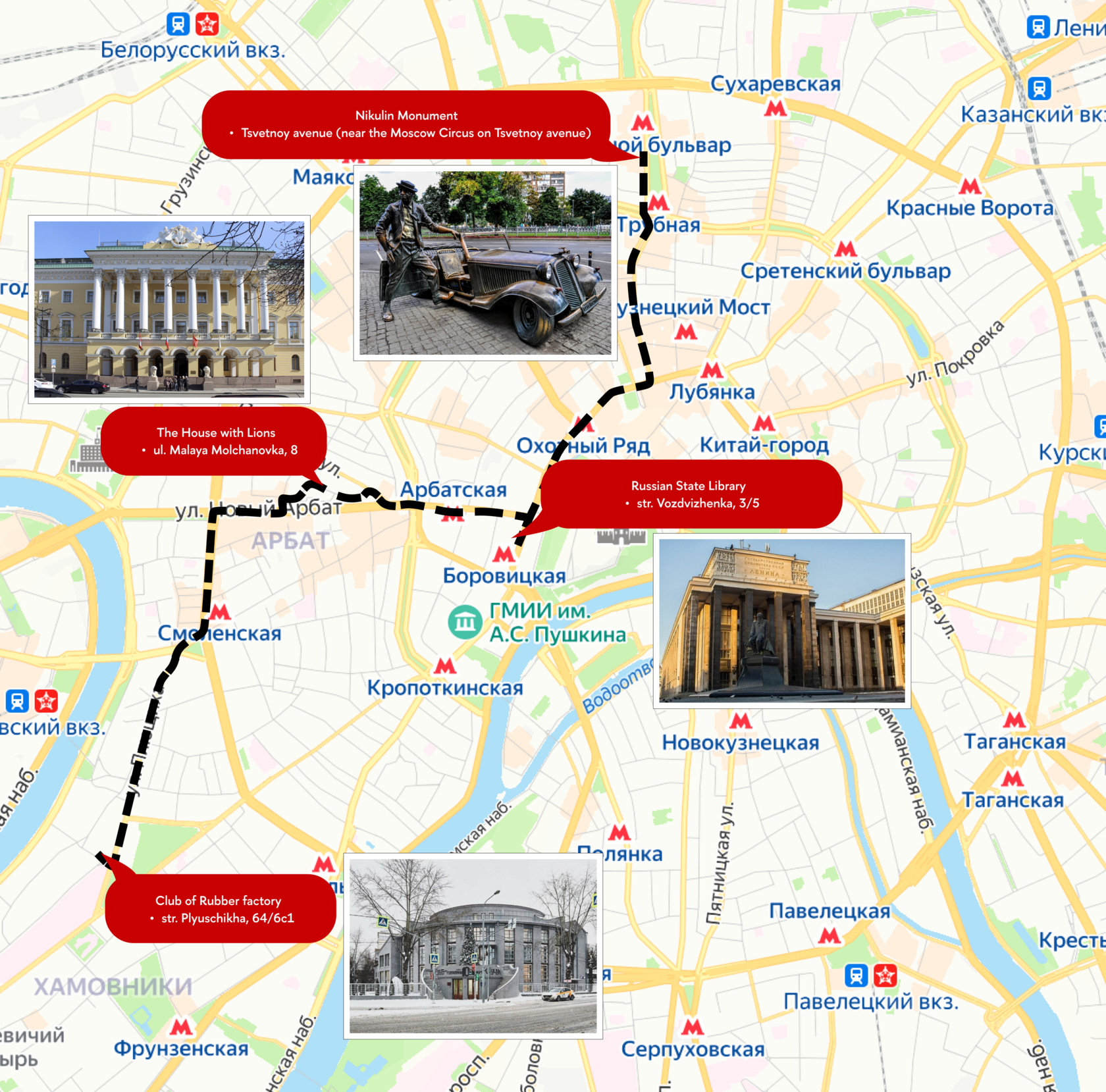
Russian State Library
Address: str. Vozdvizhenka, 3/5
Address: str. Vozdvizhenka, 3/5
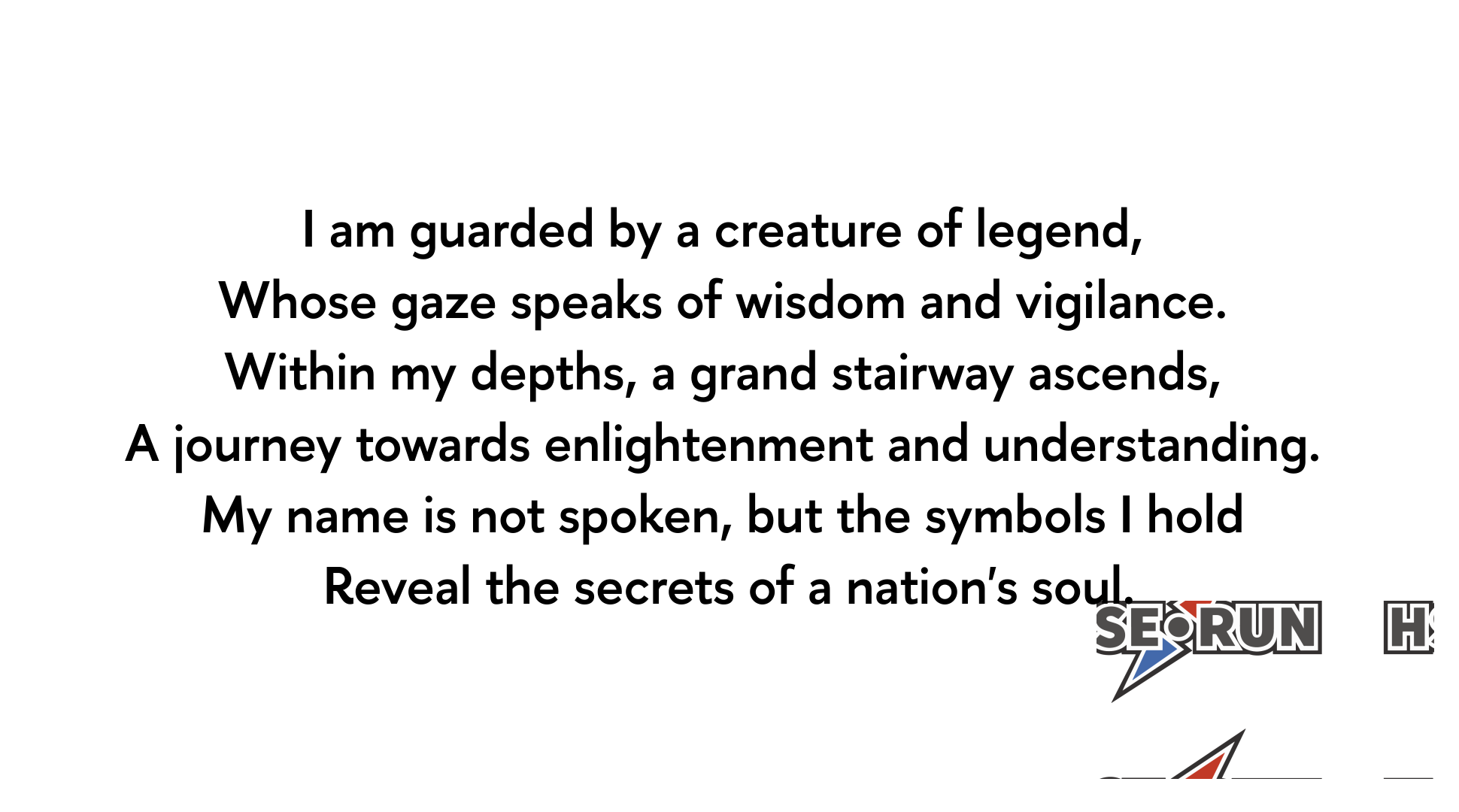
First riddle
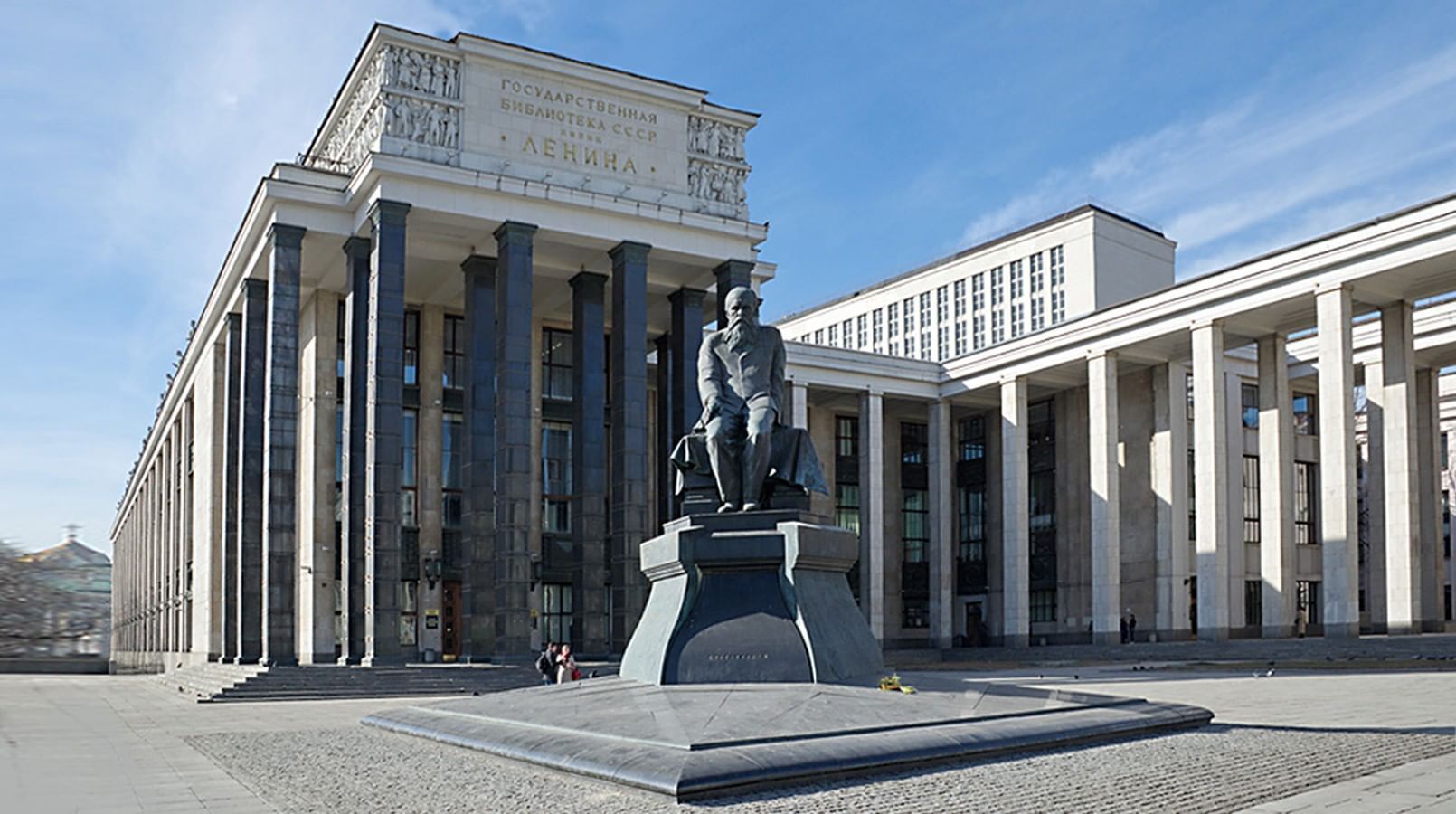
The path to the creation of the Russian State Library began in the 19th century with the rich library of Count Nikolai Rumyantsev. He gave the state more than 28 thousand volumes, including rare old printed books and manuscripts.



In 1927, a competition was announced for the design of a new building for the Lenin Library, located near the Kremlin. However, an out-of-competition work, whose authors were the famous architects Vladimir Shchuko and Vladimir Gelfreich, who were also famous for creating the Lenin Monument near the Finland Station in St. Petersburg, won the competition.
The construction of this grandiose architectural monument, one of the most interesting in Soviet architecture, stretched for three whole decades - from 1928 to 1958.
Architects Shchuko and Gelfreich designed a complex of five buildings forming a system of courtyards. The project harmoniously combines elements of ancient architecture and Soviet constructivism. The facade of the main building, faced with granite and limestone, is decorated with bronze bas-reliefs with portraits of prominent figures of science, such as Archimedes, Lomonosov, Darwin...
The construction of this grandiose architectural monument, one of the most interesting in Soviet architecture, stretched for three whole decades - from 1928 to 1958.
Architects Shchuko and Gelfreich designed a complex of five buildings forming a system of courtyards. The project harmoniously combines elements of ancient architecture and Soviet constructivism. The facade of the main building, faced with granite and limestone, is decorated with bronze bas-reliefs with portraits of prominent figures of science, such as Archimedes, Lomonosov, Darwin...
The interiors of the library are also impressive, decorated with marble, oak panelling and bronze. The staircase leading from the lobby to the reading rooms, symbolising the ascent to the light of knowledge, is particularly grandiose. It leads to a gallery with balconies adorned with decorative lattices and floor lamps on marble pillars. The room is further enhanced by graceful columns with gilded capitals.
The most famous reading room of the Russian State Library is the third one, where the perky Lyudochka from the film ‘Moscow Does Not Believe in Tears’ was looking for a decent candidate for a husband. Recently the hall has been opened after restoration. In addition to the renovation of the interiors decorated with precious wood, the monumental painting panel was restored and wi-fi was installed here.
The most famous reading room of the Russian State Library is the third one, where the perky Lyudochka from the film ‘Moscow Does Not Believe in Tears’ was looking for a decent candidate for a husband. Recently the hall has been opened after restoration. In addition to the renovation of the interiors decorated with precious wood, the monumental painting panel was restored and wi-fi was installed here.
The House with Lions
Address: str. Malaya Molchanovka, 8
Address: str. Malaya Molchanovka, 8
Second riddle
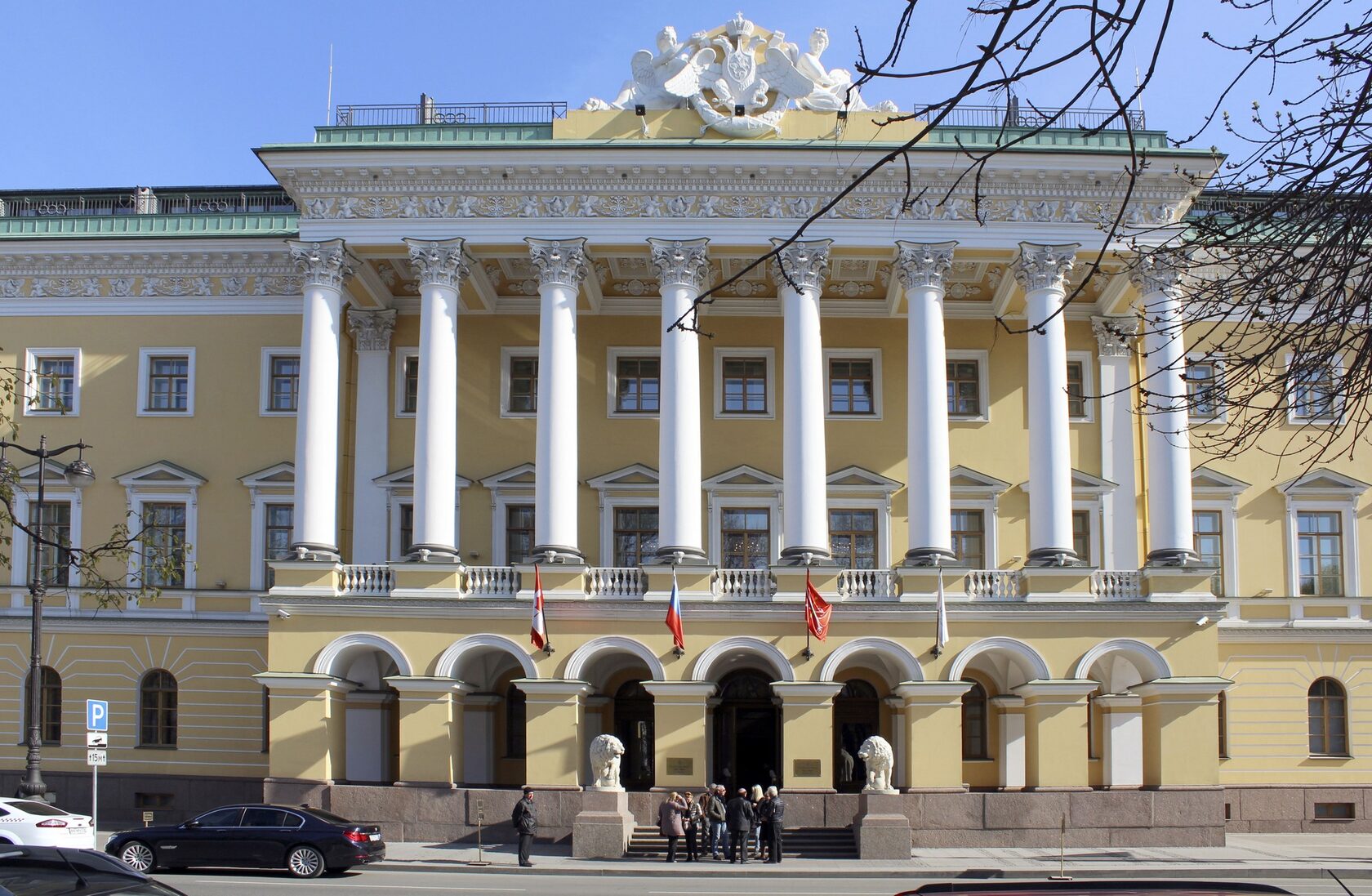
The house with its rich history and unique architecture has repeatedly become the setting for popular, and sometimes even cult, films.
In 1958, it was here that the scene of the ‘communal flat’ in Eldar Ryazanov's film ‘The Girl without an Address’ was filmed. It was here that Pashka Gusarov searched for Katerina, arousing the suspicion of the tenants, who reported him to the police.
In 1958, it was here that the scene of the ‘communal flat’ in Eldar Ryazanov's film ‘The Girl without an Address’ was filmed. It was here that Pashka Gusarov searched for Katerina, arousing the suspicion of the tenants, who reported him to the police.
On Malaya Molchanovka Street stands a majestic building in the Italian Renaissance style. Its main façade is decorated with three massive arched niches, flanked by two sculptures of regal lions. It was these lion sculptures that gave the street the unofficial name ‘the street where the house with lions is’ before the revolution.
The house, known as the Gordon-Shugaev House, was designed by a group of famous Moscow architects: Ivan Kondratenko, Semyon Doroshenko and Vasily Volokitin. The construction was completed by 1914.
The Gordon-Shugaev house became a meeting place for famous personalities. In 1917-1918 in flat No. 19 on the fifth floor lived the writer Alexei Tolstoy and his wife Natalia Krandievskaya. Poets Nikolai Klyuev and Sergey Yesenin often visited them.
The Gordon-Shugaev house became a meeting place for famous personalities. In 1917-1918 in flat No. 19 on the fifth floor lived the writer Alexei Tolstoy and his wife Natalia Krandievskaya. Poets Nikolai Klyuev and Sergey Yesenin often visited them.
In 1971, Leonid Gaidai ‘settled’ Lyapis Trubetskiy, one of the heroes of the film ‘12 Chairs’, in this house. Kisa Vorobyaninov, played by Sergei Filippov, was also seen at the entrance with lions.
Today in the former Gordon-Shugaev profitable house there are 27 flats with the area from 120 to 340 square metres with the ceiling height under 4 metres.
During the last large-scale reconstruction the house was equipped with lifts, duplex flats and ‘summer gardens’, but the former 3 stairwells and the ‘back door’, which is available from all flats, remained unchanged.
Today in the former Gordon-Shugaev profitable house there are 27 flats with the area from 120 to 340 square metres with the ceiling height under 4 metres.
During the last large-scale reconstruction the house was equipped with lifts, duplex flats and ‘summer gardens’, but the former 3 stairwells and the ‘back door’, which is available from all flats, remained unchanged.



Club of Rubber factory
Address: str. Plyuschikha, 64/6c1
Address: str. Plyuschikha, 64/6c1
Third riddle

In the turbulent 1920s and 30s, Moscow experienced a real boom in club life, and Konstantin Melnikov, a sought-after architect of the time, designed five clubs at once. Orders came from trade unions of various industries: communal workers, tanners, chemists.
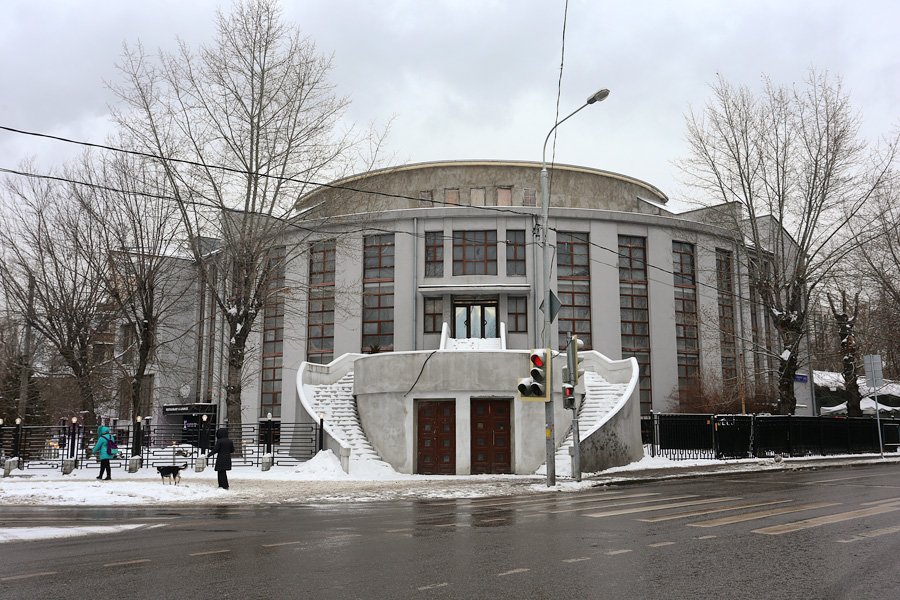
In 1927, the foundation was laid for the club named after the 10th Anniversary of the October Revolution, built to Melnikov's design for the Kauchuk Company, which produced rubber products.
The Workers‘ Club, commissioned by the Chemists’ Trade Union, was designed by Melnikov in co-authorship with Heinrich Carlsen, an engineer of wooden structures. The building's location at the intersection of Plyuschikha and Trudzhenikov Lane inspired the architects' corner solution, emphasised by the cylindrical shape with ribbon glazing.
In the centre of the building was a three-tiered amphitheatre for 750 seats, located in the cylindrical part of the club. The single-storey volume of the facade accommodated the entrance area and ticket office, while its flat roof was to serve as a podium for rallies. A balcony for spectators was located above the third floor.
The Workers‘ Club, commissioned by the Chemists’ Trade Union, was designed by Melnikov in co-authorship with Heinrich Carlsen, an engineer of wooden structures. The building's location at the intersection of Plyuschikha and Trudzhenikov Lane inspired the architects' corner solution, emphasised by the cylindrical shape with ribbon glazing.
In the centre of the building was a three-tiered amphitheatre for 750 seats, located in the cylindrical part of the club. The single-storey volume of the facade accommodated the entrance area and ticket office, while its flat roof was to serve as a podium for rallies. A balcony for spectators was located above the third floor.



In 1929, when the Kauchuk club opened, the Moscow Construction magazine praised the project, noting its non-standard solution.
The Kauchuk building has changed many guises in its history. It was a theatre, a cinema, a Chinese restaurant ‘Golden Dragon’ and even an art centre of the Academy of Russian Art. In the early 1950s, in an attempt to make the building's modernist architecture, with its curved walls and marble panelling, look more pompous, it underwent a major renovation. The result was an overabundance of decorative elements - gilded mouldings, ceiling paintings - which made it look overloaded.
Today, this former working club, which, we would like to remind you, claimed to be included in the UNESCO list, belongs to the I.M. Sechenov First Moscow State Medical University.
Nikulin Monument
Address: Tsvetnoy avenue (near the Moscow Circus on Tsvetnoy avenue)
Address: Tsvetnoy avenue (near the Moscow Circus on Tsvetnoy avenue)
Fourth riddle

On Tsvetnoy Boulevard, near the circus building, stands a bronze sculpture dedicated to the great Yuri Nikulin. It seems to invite us to sit in a cabriolet, familiar from the film ‘The Caucasian Captive’, as if it came off the screen.
Yuri Nikulin is a favourite artist whose name is inextricably linked with the legendary film and the image of Balbes, despite his negative character. Nikulin was known throughout the USSR not only for his roles in Leonid Gaidai's films, but also for many others, where he masterfully embodied both frivolous characters and serious ones. But not only cinema made him famous. Nikulin was a famous clown, and it was the Circus on Tsvetnoy Boulevard that became the starting point of his career - first as a clown and then as a director.
Yuri Nikulin is a favourite artist whose name is inextricably linked with the legendary film and the image of Balbes, despite his negative character. Nikulin was known throughout the USSR not only for his roles in Leonid Gaidai's films, but also for many others, where he masterfully embodied both frivolous characters and serious ones. But not only cinema made him famous. Nikulin was a famous clown, and it was the Circus on Tsvetnoy Boulevard that became the starting point of his career - first as a clown and then as a director.
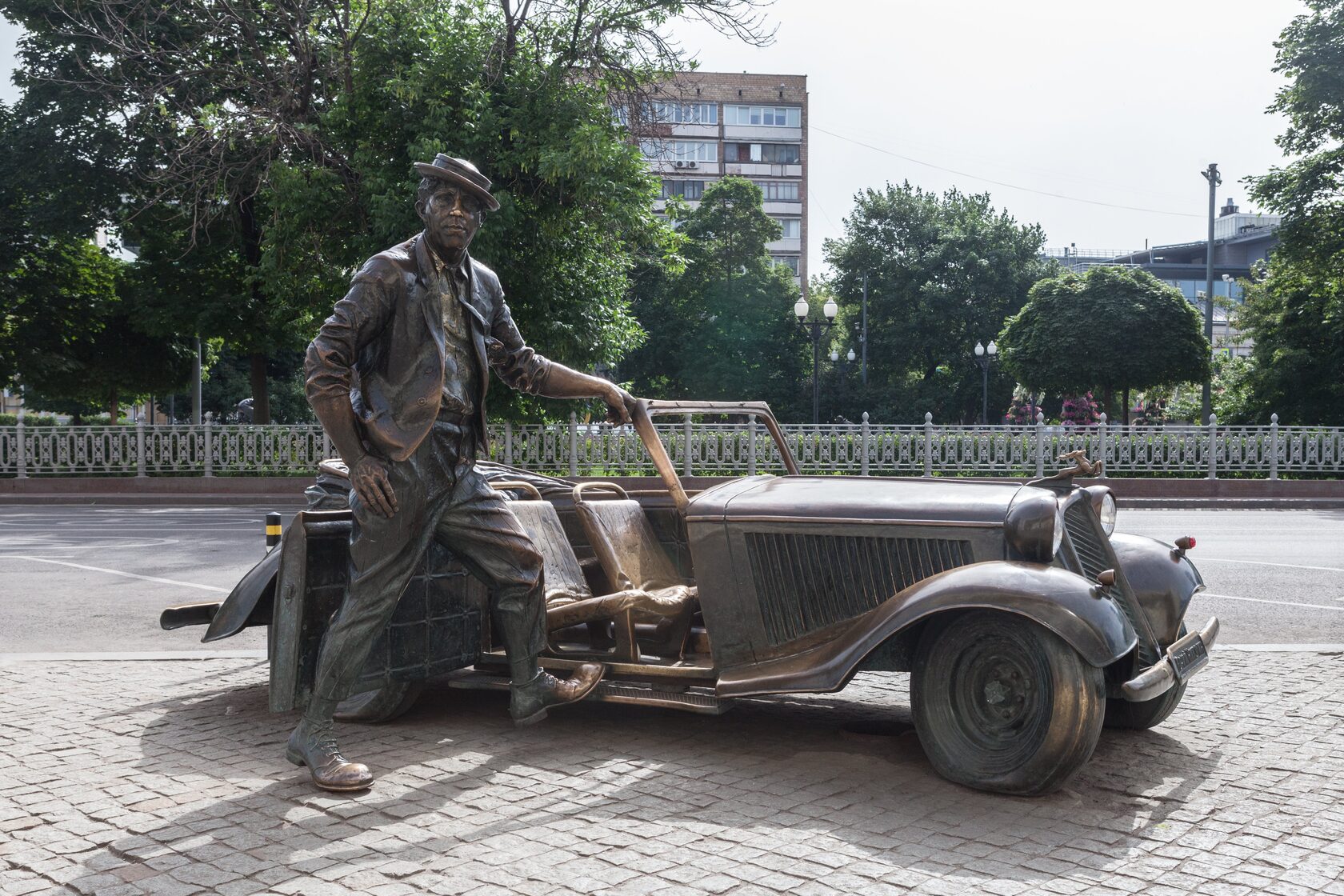


After Nikulin's death, in order to immortalise his memory, the circus staff decided to erect a monument. Fundraising took two years, $350,000 was raised, and during this time they were looking for a suitable image for the monument. Out of many proposals was chosen option, where Nikulin is presented in the image of a clown, next to the legendary cabriolet from ‘The Caucasian Captive’. Interestingly, this bright orange car was not a prop from the film, but Yuri Nikulin's personal car, an ‘Adler Trumf’ made in Germany in the 1930s. The deer on the bonnet was most likely installed by Nikulin himself for beauty or filming purposes.
The monument was created by sculptor Alexander Rukavishnikov, who also made the monument at the Novodevichy Cemetery, where Nikulin is buried.
The grand opening of the monument took place on 3 September 2000. Initially they wanted to install it on the edge of the carriageway of Tsvetnoy Boulevard, but the Moscow traffic police did not give permission. Interestingly, the sculpture of Yuri Nikulin was cast in Italy, and the cabriolet - in Minsk.
By the way, the image of Yuri Nikulin in sculptures can be found not only in Moscow, but also in other cities of Russia. Only in Moscow, in addition to this composition, there are two more: Private Nekrasov from ‘They Fought for the Motherland’ near the Ministry of Defence building and the janitor Tikhon from ‘The Twelve Chairs’ at the entrance to the Yunost Hotel.
The monument was created by sculptor Alexander Rukavishnikov, who also made the monument at the Novodevichy Cemetery, where Nikulin is buried.
The grand opening of the monument took place on 3 September 2000. Initially they wanted to install it on the edge of the carriageway of Tsvetnoy Boulevard, but the Moscow traffic police did not give permission. Interestingly, the sculpture of Yuri Nikulin was cast in Italy, and the cabriolet - in Minsk.
By the way, the image of Yuri Nikulin in sculptures can be found not only in Moscow, but also in other cities of Russia. Only in Moscow, in addition to this composition, there are two more: Private Nekrasov from ‘They Fought for the Motherland’ near the Ministry of Defence building and the janitor Tikhon from ‘The Twelve Chairs’ at the entrance to the Yunost Hotel.
